
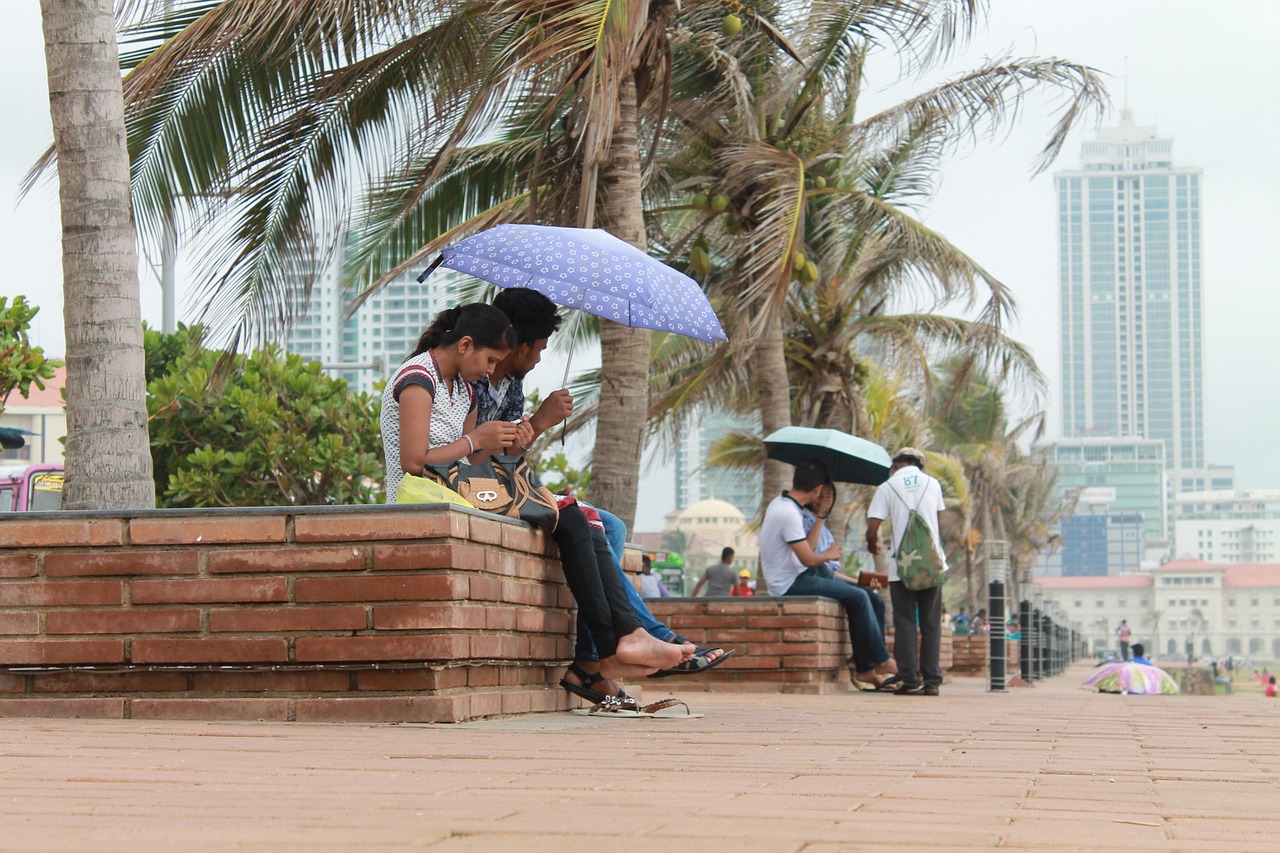
Colombo, the capital of Sri Lanka, has a tropical monsoon climate characterized by year-round heat and humidity. The annual average temperature hovers between 26°C and 30°C, with virtually no monthly variation — even the coolest months of December and January average 25.5°C, while the hottest period in April and May reaches only 29°C, meaning the annual temperature range is a mere 3.5°C. Temperatures generally stay within 23°C–32°C throughout the year, rarely exceeding 34°C.
The real driver of Colombo’s weather is not temperature but rainfall and monsoon direction. Annual precipitation reaches approximately 2,365mm, brought by two distinct monsoon seasons. High humidity and frequent cloud cover make the feels-like temperature noticeably higher than the actual reading — which means lightweight, breathable summer clothing is essential no matter when you visit.
Seasonal Weather in Colombo
Unlike destinations with four seasons, Colombo’s climate is defined by dry seasons and wet seasons, with temperatures remaining almost constant at 23°C–32°C year-round. What truly changes month to month is rainfall.
Dry Season (December – March)
This is the most comfortable and travel-friendly time in Colombo. Temperatures range from a low of 24°C to a high of 32°C — the coolest of the year — and relatively lower humidity makes outdoor activities genuinely pleasant. Although the northeast monsoon is active during this period, it delivers rain to the northeastern coast of Sri Lanka, leaving Colombo and the western and southern regions sunny and dry. Rainfall drops sharply: 158mm in December, 115mm in January, and just 34mm in February — the driest month of the year. With an average of 9–10 hours of sunshine per day and calm seas ideal for swimming, this is peak tourist season in Colombo.
Transitional Period (April – May)
This is the shift from dry to wet season, and also the hottest time of the year. Highs reach 34°C in March and remain at 33°C in April, while humidity climbs rapidly. Sudden afternoon squalls and thunderstorms become increasingly frequent. Rainfall surges to 177mm in April and 355mm in May — the month with the highest chance of rain at 77% of the year. Humidity rises to 80–86%, making the feels-like temperature far higher than the thermometer shows. April 14th marks the Sinhala and Tamil New Year, bringing a festive atmosphere to the city, but the heat and humidity add to travel challenges.
Southwest Monsoon (June – September)
The southwest monsoon arrives in full force, concentrating rainfall over Colombo and the western and southern regions. Temperatures actually ease slightly to a maximum of 30–31°C compared to the transition period, but rainfall averages around 250mm per month: 242mm in June, 222mm in July, 236mm in August, and 256mm in September. Rain falls on 27–29 days of the month, with a 66–77% daily chance of precipitation. Humidity sits at 85–86%, pushing the feels-like temperature well above the actual reading. Seas are rough, making beach activities and water sports essentially impossible. River levels can rise significantly and flooding is a risk, so outdoor itineraries require careful planning.
Late Monsoon Transition (October – November)
As the southwest monsoon retreats and the northeast monsoon approaches, this transition period paradoxically brings the heaviest rainfall of the year to Colombo. October records 384mm and November 452mm — the highest of any month. Temperatures cool slightly to a maximum of 30°C, with overnight lows of 24–25°C, but intense downpours, lightning, and thunder occur multiple times a day. Humidity peaks at 87% — the highest of the year — and sunshine drops to just 7.8–8.5 hours per day. However, rainfall begins to gradually ease in late November, signaling the start of the approaching dry season.
Best Time to Visit Colombo
The best time to visit Colombo is during the dry season from December to March.
December through February is the absolute prime time to visit. Rainfall is at its lowest, humidity is manageable, and the city enjoys 9–10 hours of sunshine daily. Temperatures of 24°C–32°C feel comfortable for both sightseeing and beach activities. This is Colombo’s official peak tourist season, attracting visitors from around the world — so flights and accommodation should be booked at least 2–3 months in advance.
March to early April marks the tail end of the dry season. Skies remain mostly clear and rainfall is still relatively low, but temperatures begin rising sharply, reaching 33–34°C by late March and April. Strong UV rays and intense heat call for extra precautions when spending time outdoors.
May through September is the southwest monsoon wet season, with a 66–77% daily chance of rain and rough seas that make beach activities impossible. October and November are the wettest months of the year (384mm and 452mm respectively), making outdoor sightseeing difficult — the off-season for tourism. That said, even during the wet season, most rain falls as brief tropical squalls rather than all-day downpours, so budget travelers willing to work around the weather can take advantage of significantly lower accommodation rates by focusing on indoor attractions.
Monthly Weather & What to Wear
In Colombo, temperatures barely shift between 24°C and 34°C all year, so the real variable each month is rainfall. Regardless of the month, always dress in summer clothes — and never leave without sunscreen and an umbrella.
January
Temperature: 24°C – 32°C | Peak dry season — the most pleasant month of the year. Rain falls on around 12 days (115mm total), with 9.5 hours of sunshine daily and humidity at 77%.
What to Wear: Light, breathable short-sleeve tops and shorts in cotton or linen; sandals. UV index reaches 7.2 (very high), so a wide-brim hat, sunglasses, and SPF 50+ sunscreen are essential. Carry a compact umbrella just in case.
February
Temperature: 24°C – 34°C | The hottest and driest month of the year. Only 34mm of rain falls on roughly 6 days, with 10.7 hours of sunshine — the most of any month. Humidity drops to 69%, the lowest of the year.
What to Wear: Bright, lightweight short-sleeve tops and shorts; sandals or light sneakers. UV index peaks at 8.6 (very high) — the strongest of the year — so SPF 50+ sunscreen and a hat are non-negotiable.
March
Temperature: 25°C – 34°C | Still hot, tied with February as the warmest month. Rainfall is 98mm over 16 days, with 10.5 hours of sunshine and 74% humidity. The last month of the dry season, though afternoon showers begin creeping in.
What to Wear: Cooling-fabric short-sleeve tops, shorts, and sandals. Choose loose, breathable fabrics to handle the strong heat, and add a hat, sunglasses, sunscreen, and a light umbrella.
April
Temperature: 25°C – 33°C | The transitional month into wet season. Rain falls on 26 days (177mm total) and humidity climbs to 81%, raising the feels-like temperature considerably. The Sinhala and Tamil New Year on April 14th brings a lively festive atmosphere.
What to Wear: Moisture-wicking short-sleeve tops, shorts, and light sandals or water-resistant shoes. A foldable umbrella or light rain jacket is essential as squalls are frequent.
May
Temperature: 26°C – 31°C | The southwest monsoon begins in earnest. Rain falls on virtually every day of the month (355mm total, 77% daily rain chance) and humidity reaches 86%.
What to Wear: Quick-dry short-sleeve tops, shorts, and waterproof sandals or light waterproof sneakers. An umbrella or rain jacket is a must. Pack a thin cardigan for heavily air-conditioned indoor spaces.
June
Temperature: 26°C – 31°C | Monsoon at its most intense. Rain on 29 days (242mm), humidity 86%. Seas are rough and beach activities are not possible.
What to Wear: Moisture-wicking short-sleeve tops, shorts, and waterproof sandals. Umbrella or rain jacket required. Always pack a thin long-sleeve or cardigan for air-conditioned venues.
July
Temperature: 26°C – 30°C | Monsoon continues. Rain on 28 days (222mm), humidity 85%. Sudden downpours can occur at any hour.
What to Wear: Light, breathable short-sleeve tops, shorts, and waterproof shoes. An umbrella or raincoat and a thin long-sleeve are essential. Temperatures ease slightly, reducing physical strain compared to peak summer.
August
Temperature: 26°C – 30°C | Wet season continues. Rain on 27 days (236mm), humidity 85%. UV index remains at 7.1 (very high) — don’t skip sunscreen just because it’s cloudy.
What to Wear: Quick-dry short-sleeve tops, shorts, waterproof sandals or light sneakers. Keep an umbrella handy and pack a thin layer for air-conditioned spaces. Choose footwear that dries quickly.
September
Temperature: 25°C – 30°C | Wet season continues but begins to ease slightly. Rain on 29 days (256mm), humidity 86%.
What to Wear: Short-sleeve tops, shorts, waterproof sandals or light sneakers. An umbrella or rain jacket is essential, along with a thin cardigan for indoor cooling.
October
Temperature: 25°C – 30°C | Monsoon transition — rainfall surges to 384mm, the second-highest of the year. Rain on 29 days, humidity peaks at 87%, with 8.5 hours of sunshine.
What to Wear: Light short-sleeve tops, shorts, thin long-sleeve option, sandals or light sneakers. Heavy rain makes an umbrella or rain jacket absolutely essential. Don’t forget a hat and sunglasses.
November
Temperature: 24°C – 30°C | The wettest month of the year — 452mm of rain, falling on 25 days. Humidity 87%, sunshine just 7.8 hours — the cloudiest month of the year.
What to Wear: Quick-dry, water-resistant short-sleeve tops, shorts, and waterproof shoes. An umbrella or rain jacket is a must. Rainfall begins tapering off in late November as the dry season approaches.
December
Temperature: 24°C – 31°C | The dry season returns. Rainfall drops to 158mm over 17 days, with sunshine increasing to 9.2 hours. Tourist numbers begin to surge as peak season kicks off.
What to Wear: Light, breathable short-sleeve tops and shorts in cotton or linen; sandals. Bring a hat, sunglasses, and SPF 50+ sunscreen, along with a compact umbrella for the occasional passing shower.
Colombo Monthly Climate Data
| Month | Max Temp (°C) | Min Temp (°C) | Rainfall (mm) | Humidity (%) |
| January | 32 | 24 | 115 | 77 |
| February | 34 | 24 | 34 | 69 |
| March | 34 | 25 | 98 | 74 |
| April | 33 | 25 | 177 | 81 |
| May | 31 | 26 | 355 | 86 |
| June | 31 | 26 | 242 | 86 |
| July | 30 | 26 | 222 | 85 |
| August | 30 | 26 | 236 | 85 |
| September | 30 | 25 | 256 | 86 |
| October | 30 | 25 | 384 | 87 |
| November | 30 | 24 | 452 | 87 |
| December | 31 | 24 | 158 | 81 |