
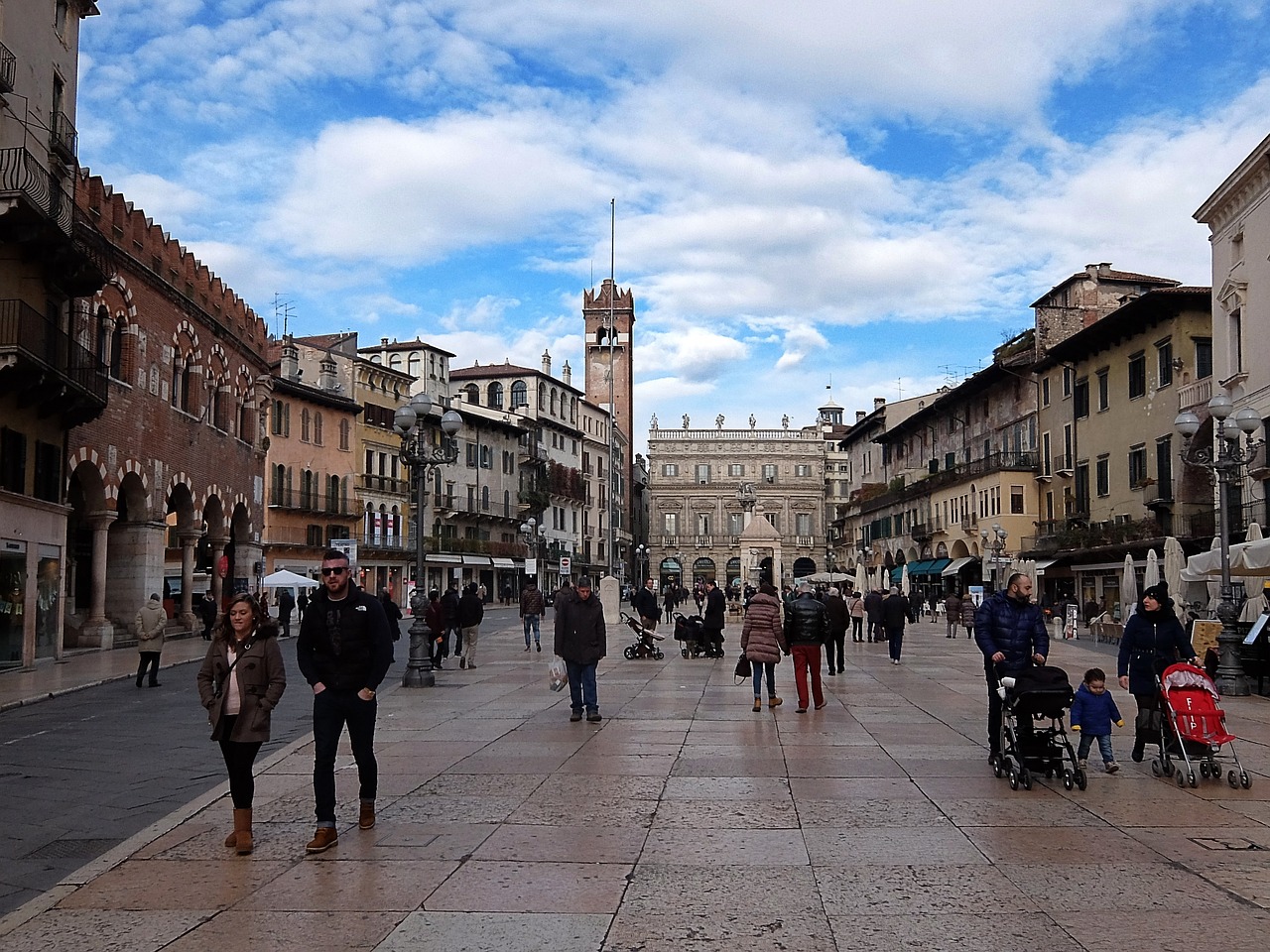
Overview of Verona’s Climate
Verona, located in the Po Valley of Northern Italy, experiences a humid subtropical climate with cold, wet winters and hot summers. The city has an annual average temperature of 12.7°C, ranging from -1°C in January to 29°C in July, creating a total temperature variance of 21.7°C throughout the year. The annual precipitation averages approximately 820mm, with May being the wettest month (85mm), and fog frequently occurs from early morning to late morning during winter months.
Verona’s Seasonal Weather
Spring (March-May)
Spring is a mild season when temperatures begin to rise steadily from March, reaching an average of 18.3°C by May. Sunshine hours gradually increase, with May offering approximately 8 hours of daily sunlight, creating ideal conditions for outdoor activities. Precipitation increases throughout the spring, ranging from 70-75mm in April and May, so bringing an umbrella is advisable. The tourism season officially begins in April, providing pleasant weather and excellent conditions for outdoor sightseeing.
Summer (June-August)
Summer is hot and humid, with temperatures peaking at 22.5°C in June, 24.7°C in July, and 24.5°C in August, with highs frequently exceeding 30°C. Humidity remains between 65-69%, while sunshine hours reach their annual maximum of 9-10 hours monthly. However, sudden thunderstorms may occur in the afternoons and evenings. Heat waves can push temperatures above 35°C, with the record high temperature of 39°C recorded in August 2003.
Autumn (September-November)
Autumn is characterized by gradually decreasing temperatures, from 19.8°C in September to 8.6°C in November, with daylight hours diminishing rapidly. Humidity increases to 74-87%, particularly in October and November when it reaches 82-87%. Monthly precipitation is relatively high at 75-80mm, with October being the wettest month at approximately 80mm. Sunshine hours decrease from 4-7 hours, and overcast conditions become increasingly common after October.
Winter (December-February)
Verona’s winter is cold, wet, and gray, with average temperatures around 3.7°C and January lows reaching -0.7°C. The sky remains cloudy for extended periods, humidity reaches 81%, and while fog forms frequently, snow is rare—averaging only about 10cm annually. Cold air masses from Eastern Europe can create severe frost conditions, with historical records showing temperatures as low as -18.5°C. Monthly precipitation is modest at 35-40mm, with rain occurring on approximately 5 days per month.
Best Times to Visit Verona
Spring (April-May): Optimal Visiting Period
The best time to visit Verona is from mid-April through mid-June, spanning spring and early summer. April’s average temperature of 13.3°C marks the beginning of warmer weather, while May’s daytime temperatures reach a comfortable 23.9°C, ideal for outdoor sightseeing. This period provides pleasant conditions for appreciating historic architecture and natural landscapes. However, April and May receive 70-85mm of rainfall, so umbrella preparation is essential.
Early Summer (June): Tourism Season Begins
June marks the transition from spring’s rainy season to summer warmth, with daytime temperatures reaching approximately 28°C and sunshine hours increasing to 9 hours monthly. Although June precipitation remains high at 85mm, most rainfall concentrates in afternoons and evenings, allowing morning and early afternoon sightseeing. With daylight hours extending to 15 hours 35 minutes, there is ample time for tourism, making June increasingly popular with visitors.
Summer (July-August): Intense Heat and Evening Activities
July and August are Verona’s hottest months, with daytime temperatures exceeding 30°C and nighttime temperatures around 20°C. While afternoon and evening thunderstorms are possible, humidity and warm summer nights create perfect conditions for evening dining and cultural performances. Afternoon indoor activities—such as visiting museums and galleries—are recommended during peak heat hours.
Early Autumn (September): Secondary Optimal Period
September offers another excellent visiting window with comfortable daytime temperatures of 25°C and humidity dropping to 74%. Although monthly precipitation reaches 80mm, stable weather provides pleasant outdoor tourism conditions. Tourism crowds diminish significantly from summer peaks, and the daylight length of 12 hours 30 minutes allows adequate sightseeing time.
Mid-Autumn (October): Scenic Beauty and Reduced Crowds
October showcases Verona at its most beautiful, with daytime temperatures cooling to 18.6°C and natural colors transforming. However, October is the wettest month with 86mm of average rainfall and 7 expected rainy days, so indoor activity scheduling is necessary. Although humidity reaches 82% and sunshine hours reduce to 4 hours, sharply decreased tourist numbers permit a more leisurely Verona experience.
Late Autumn and Winter (November-March): Periods to Avoid
November through March are not recommended for Verona visits. November temperatures drop to 12.4°C, while December through February remain cold at 3-5°C with humidity at 81-87%. Sunshine hours are very short at 3-4.5 hours daily, creating predominantly overcast conditions, and precipitation of 35-55mm monthly brings frequent rain. Limited daylight hours make it difficult to fully appreciate historic architecture and outdoor cultural heritage, making warm season visits the optimal choice for experiencing Verona’s authentic beauty.
Verona’s Monthly Weather & Recommended Clothing
January
January is Verona’s coldest month, with daytime temperatures averaging only 5-7°C and nighttime temperatures plummeting to -0.7°C.
Although monthly precipitation is modest at 52mm, humidity reaches an extreme 87%, and just 3 hours of daily sunshine create consistently overcast, dark conditions.
Historical record lows have reached -18.5°C, requiring preparation for severe cold.
Recommended attire: Warm coats, wool sweaters, tights, boots, gloves, hats, and scarves are essential winter items, with emphasis on indoor activities.
February
February is slightly warmer than January but remains cold, with daytime temperatures averaging 8°C and nighttime temperatures at 0.4°C.
Monthly precipitation decreases slightly to 50mm, but humidity remains high and sunshine hours are still low at 4.5 hours.
Snow is possible, making thermal wear essential.
Recommended attire: Similar to January—warm coats, 2-3 wool sweaters, long-sleeve shirts, and waterproof outerwear are necessary.
March
March marks the winter-to-spring transition, with daytime temperatures beginning to rise to an average of 13°C while nighttime temperatures remain chilly at approximately 3°C.
Monthly precipitation increases to 61mm and humidity remains high, but sunshine hours gradually extend to 5.5 hours.
Recommended attire: Layering is key—long-sleeve shirts, sweaters, lightweight jackets, waterproof windbreakers, tights, and comfortable shoes allow flexible responses to changing weather.
April
April brings spring’s onset with daytime temperatures warming to 17-18°C and nighttime temperatures rising to approximately 7°C.
Monthly precipitation remains substantial at 67mm, but spring weather patterns emerge and sunshine hours increase to 6-7 hours.
Recommended attire: Bright-colored long-sleeve tops, cardigans, lightweight jackets, jeans, comfortable walking shoes, umbrellas, or waterproof trench coats effectively handle spring’s unpredictable weather.
May
May represents peak Verona tourism season, with comfortable daytime temperatures of 22-24°C and pleasant nighttime temperatures of 11-12°C.
Although monthly precipitation remains high at 85mm, increased sunshine brings 8 hours daily, and 15-hour daylight permits extensive sightseeing.
Recommended attire: Transition to summer clothing—short-sleeve shirts, dresses, skirts, lightweight cardigans, jeans, sandals, sunglasses, and sun hats are appropriate, though thin jackets for evenings are advisable.
June
June marks early summer, with daytime temperatures reaching 26-28°C and comfortable nighttime temperatures of 17°C.
Although monthly precipitation remains high at 85-86mm, most arrives as afternoon thunderstorms, and 8-9 hours of daily sunshine support peak outdoor activities.
Recommended attire: Lightweight linen or cotton dresses, short-sleeve shirts, shorts, skirts, sandals, sunglasses, and bright, ice cream-colored clothing are appropriate, with lightweight shawls or cardigans useful for thunderstorm protection.
July
July is Verona’s hottest month, with daytime temperatures reaching 29-30°C and comfortable nighttime temperatures of 18-19°C.
Although monthly precipitation decreases to 62mm, humidity remains high at 66%, and 9 hours of daily sunshine are available.
Recommended attire: Maximum lightness and breathability are essential—linen blouses, cotton dresses, shorts, skirts, linen pants, sandals, sneakers, wide-brimmed hats, and sunscreen are critical.
August
August is Verona’s second-hottest month, with daytime temperatures of 28-30°C and sustained summer conditions.
Monthly precipitation is highest during summer at 88mm, though humidity is relatively lower at 69%.
Indoor air conditioning makes lightweight scarves or cardigans useful despite warm outdoor temperatures.
Recommended attire: Ultra-lightweight linen clothing, stretchy cotton fabrics, sandals, dresses, sun-protective long-sleeve shirts are valuable, with light scarves or cardigans addressing indoor air conditioning.
September
September transitions from summer to autumn, with daytime temperatures declining to 25°C and nighttime temperatures cooling to 14°C. Monthly precipitation decreases to 64mm and humidity drops to a more comfortable 74%, though sunshine hours begin declining to 7 hours.
Recommended attire: Reflecting autumn’s arrival—short-sleeve shirts, lightweight sweaters, cardigans, thin jackets, jeans, comfortable walking shoes, and scarves address daytime-to-evening temperature variations.
October
October marks autumn’s full arrival, with daytime temperatures cooling to 18-19°C and nighttime temperatures at 9-10°C.
October brings the year’s highest precipitation at 82-86mm with humidity at 82%, expecting frequent rain, while sunshine hours sharply decrease to 5 hours with predominant overcast conditions.
Recommended attire: Medium-weight jackets, 2-3 wool sweaters, long-sleeve shirts, water-resistant jackets, waterproof umbrellas, jeans, comfortable boots, and scarves are essential.
November
November marks the approach of winter, with daytime temperatures dropping to 12°C and nighttime temperatures reaching a chilly 4.8°C.
Monthly precipitation remains high at 79mm, humidity reaches 80%, and just 3 hours of daily sunshine create dark, overcast conditions.
Recommended attire: Winter preparation stage—1-2 warm coats, 2-3 wool sweaters, long-sleeve shirts, tights, waterproof boots, gloves, and scarves are necessary.
December
December marks winter’s onset, with daytime temperatures averaging 6°C and nighttime temperatures dropping to -1°C in a cold month.
Although monthly precipitation decreases to 53mm, humidity remains high at 81%, and just 3 hours of daily sunshine provide minimal daylight.
Recommended attire: Identical to January—warm winter coats, wool sweaters, tights, boots, gloves, hats, and scarves are essential for complete winter protection. While dressing for festive Christmas-season atmosphere, prioritize thermal protection above all considerations.
Verona’s Monthly Temperature, Precipitation & Sunshine Data
| Month | Avg. High Temp (°C) | Avg. Low Temp (°C) | Precipitation (mm) | Relative Humidity (%) | Sunrise | Sunset |
|---|---|---|---|---|---|---|
| January | 7 | -0.7 | 40 | 84 | 07:30 | 16:50 |
| February | 9.6 | 0.4 | 35 | 77 | 07:10 | 17:25 |
| March | 14.5 | 4.1 | 45 | 71 | 06:30 | 18:00 |
| April | 18.8 | 7.8 | 75 | 70 | 05:50 | 18:35 |
| May | 23.9 | 12.7 | 70 | 68 | 05:20 | 19:05 |
| June | 28 | 17 | 85 | 67 | 04:55 | 19:35 |
| July | 30.4 | 19 | 65 | 66 | 05:05 | 19:30 |
| August | 30.2 | 18.8 | 85 | 69 | 05:25 | 19:00 |
| September | 25.1 | 14.4 | 80 | 74 | 05:55 | 18:15 |
| October | 18.6 | 9.7 | 80 | 82 | 06:30 | 17:25 |
| November | 12.4 | 4.8 | 75 | 87 | 07:15 | 16:45 |
| December | 7.6 | 0 | 55 | 87 | 07:45 | 16:35 |
Data Notes:
-
Average High/Low Temperatures: Monthly average daily high and low temperatures
-
Precipitation: Average monthly rainfall, with June and August recording the highest amounts
-
Relative Humidity: Average monthly humidity levels, highest in November and December
-
Sunrise/Sunset Times: Average daily sunrise and sunset times, with June 21 (Summer Solstice) providing maximum daylight of 15 hours 35 minutes and December 21 (Winter Solstice) providing minimum daylight of 8 hours 50 minutes
Key Climate Characteristics:
-
Winter (December-February) is extremely humid (84-87% humidity) with low temperatures
-
Summer (July-August) represents the year’s hottest season
-
Precipitation is distributed relatively evenly throughout the year, with slight increases in April-June and August-October
-
Sunshine hours vary dramatically, from 3 hours in January to 10 hours in July