
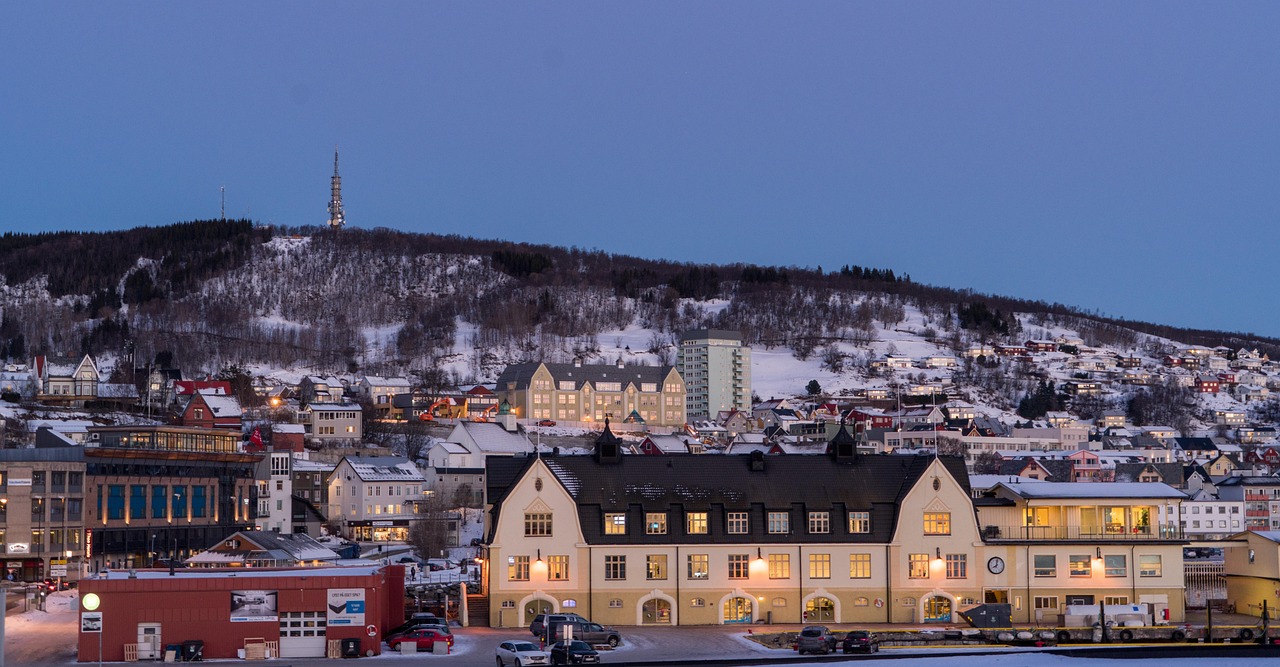
Tromsø is an Arctic city in northern Norway, located at 69°N, and it has a subarctic, oceanic Arctic climate. Temperatures range from about -6°C in winter to 15°C in summer, with January averaging a low of -7°C and July averaging a high of 18°C. Winter lasts a long time and is harsh, with frequent snow and strong winds, while the Polar Night lasts for about two months and keeps the sun below the horizon. In contrast, summer brings the Midnight Sun, when the sun does not set for 24 hours and temperatures stay cool at around 15°C. Rainfall is spread fairly evenly throughout the year, averaging around 100mm annually, with October as the wettest month at 125mm and May as the driest at 54mm. Aurora viewing is possible from September to March, and the peak season is December through February, when travelers from around the world flock to Tromsø.
Seasonal Weather in Tromsø
Spring (March – May)
Spring in Tromsø still feels wintry, with snow and cold lingering well into the season. March averages a high of 0°C and a low of -5°C, and it is also the wettest month in terms of rainy or snowy days, with about 20 days of precipitation. In April, temperatures slowly rise to a high of 2°C, and by May they reach around 8°C as the snow begins to melt quickly. On May 19, the Midnight Sun begins, and the city starts to receive around 20.4 hours of daylight per day. Spring is a transition season where the end of aurora season overlaps with the beginning of midnight sun season, and it is also the last chance to enjoy skiing and snow activities.
Summer (June – August)
Summer is the warmest season in Tromsø, but it is still a cool summer by most standards, with highs only reaching 14–18°C. July is the warmest month, averaging a high of 18°C and a low of 11°C, making it ideal for hiking and fjord exploration. From May 19 to July 27, the sun does not set at all, creating the unique experience of full 24-hour daylight. July has about 15 rainy days, the lowest of the year, while August rises again to 19 rainy days. Summer is the busiest tourist season, and outdoor activities such as fjord cruises, hiking, and kayaking are especially popular.
Autumn (September – November)
Autumn is one of the best times to visit Tromsø, especially because the aurora season begins in September. September is still cool but not yet brutally cold, with an average high of 12°C and a low of 7°C, making it a great month for combining northern lights viewing with trekking and fjord sightseeing. In October, temperatures fall sharply to a high of 5°C and a low of 1°C, and the landscape turns into a colorful autumn scene. On November 29, the Polar Night begins, and dark days without the sun above the horizon start to take over; by then, November averages a high of 0°C and a low of -4°C, marking the arrival of true winter. Autumn is one of the best seasons for whale watching, dog sledding reservations, and the first northern lights of the season.
Winter (December – February)
Winter is both the harshest and the most magical season in Tromsø. From November 29 to January 16, full Polar Night lasts, meaning the sun does not rise at all. January averages a high of -3°C and a low of -7°C, and wind chill can push the perceived temperature below -20°C. Yet this is also the peak season for northern lights viewing, when the sky is darkest and the aurora often appears in vivid green, purple, and pink. December through February sees the highest aurora viewing chances, and this is when travelers from all over the world come to Tromsø. Winter activities such as dog sledding, snowmobiling, ice fishing, and reindeer safaris also concentrate during this period. December is also the driest month of the year, with about 13 rainy or snowy days.
Best Time to Visit Tromsø
Tromsø is a destination where the best time to visit depends strongly on your travel purpose.
Northern Lights Season (September – March)
The best time to see the northern lights is from September to March, with January and February being the most recommended months. Tromsø is one of the world’s top aurora destinations, with more than 100 aurora-viewing days per year and roughly a one-in-three-day chance of seeing the lights. January and February often bring clearer nights and darker skies because of the ongoing Polar Night, which makes the aurora appear especially vivid. Around the equinox periods in September–October and February–March, solar activity tends to strengthen the aurora. The best viewing window is generally between 6:00 PM and midnight, especially on clear nights with little moonlight.
Northern Lights + Winter Activities (December – February)
If you want to combine aurora viewing with dog sledding, snowmobiling, reindeer safaris, and whale watching, then December and January are the peak months. December is the driest month of the year, so skies are often clearer than in the wetter shoulder months. Whale-watching tours are also most promising in December and January, especially north of Tromsø in the Skjervøy area, where sightings of humpback whales are more likely.
Midnight Sun & Summer Hiking (June – July)
If northern lights are not your main focus and you want to experience the Midnight Sun and fjord hiking, then June and July are ideal. From May 19 to July 27, the sun does not set, and temperatures of 14–18°C make trekking, fjord cruises, and kayaking especially enjoyable. It is the busiest and most expensive travel period, but hiking under a bright midnight sky is a uniquely Tromsø experience.
Less Ideal Period
October is the least favorable month for outdoor activity because it has the highest precipitation of the year and strong winds. Although the aurora season is beginning, cloudy and rainy conditions often make viewing difficult, so it is generally better to avoid if flexibility is possible.
Monthly Weather and What to Wear
January
January is one of the coldest months in Tromsø, with an average high of -3°C and a low of -7°C, and wind chill can drop below -20°C. There are about 17 days of precipitation, and snow and strong winds are common under full Polar Night. It is the peak season for northern lights travelers. What to wear: a wool base layer, a wool sweater or fleece mid-layer, a waterproof and windproof insulated parka, waterproof pants, wool socks worn in two layers, thick insulated gloves, and a wool hat, scarf, and earmuffs.
February
February averages a high of -1°C and a low of -6°C, so the severe cold continues with about 17 precipitation days. The sun begins to reappear after January 16, and daylight slowly increases. It remains one of the best months for aurora viewing. What to wear: the same full winter protection as January, plus hand warmers and a thermos for outdoor northern lights tours.
March
March averages a high of 0°C and a low of -5°C, and it has the most precipitation days of the year, with about 20 days of snow or rain. Even though spring begins, winter conditions remain, making it the final chance for skiing and snowmobiling. Aurora season also continues through late March. What to wear: a thick waterproof parka, waterproof pants, wool layers underneath, and waterproof hiking boots.
April
April averages a high of 2°C and a low of -3°C, and although temperatures begin to rise, it remains cold with about 19 precipitation days. Snow, rain, and sleet are all possible. What to wear: a thick mid-layer under a waterproof, windproof outer shell, with layered clothing for temperature swings, plus waterproof hiking boots and insulated gloves.
May
May rises to an average high of 8°C and a low of 2°C, and it is one of the driest months of the year. Daylight expands to around 20.4 hours, and the Midnight Sun begins on May 19. What to wear: a thin wool base layer, a light fleece or sweater, and a waterproof jacket; keep a heavier outer layer in your bag for chilly mornings and evenings.
June
June averages a high of 14°C and a low of 8°C, marking the start of summer. It has about 16 precipitation days, one of the lowest counts of the year, and full Midnight Sun continues. It is a great month for fjord cruises, hiking, and kayaking. What to wear: a light long-sleeved shirt, a thin jacket or windbreaker, and a waterproof rain jacket with a packable umbrella.
July
July is the warmest month, averaging a high of 18°C and a low of 11°C, with about 15 precipitation days. Midnight Sun is at its brightest, and outdoor activity can continue around the clock. What to wear: a T-shirt or thin long-sleeve top, but always bring a light windproof jacket; a sleep mask is also useful because the nights stay bright.
August
August averages a high of 16°C and a low of 10°C, but precipitation rises again to about 19 days. Midnight Sun ends on July 27, and by late August the chances of seeing the aurora begin to improve slightly. What to wear: a waterproof jacket, a thin fleece or sweater, and waterproof hiking boots.
September
September averages a high of 12°C and a low of 7°C, bringing cool, comfortable weather and the start of aurora season. Rain is still fairly common, but the fjords and landscape are especially beautiful with autumn colors. What to wear: layered clothing, a light jacket topped with a waterproof outer layer, a packable umbrella, and waterproof shoes.
October
October averages a high of 5°C and a low of 1°C, and it is the wettest month of the year with around 19 precipitation days. Aurora season is fully underway, but cloud cover often makes viewing difficult. What to wear: a thick mid-layer, a waterproof and windproof outer shell, a scarf, gloves, and waterproof boots.
November
November averages a high of 0°C and a low of -4°C, and Polar Night begins on November 29. The month is dark and increasingly cold, but the aurora becomes more visible. What to wear: a heavy insulated parka, layered waterproof and windproof clothing, insulated gloves, earmuffs, and a wool hat.
December
December averages a high of -3°C and a low of -7°C, making it deeply cold, though it is also the driest month with about 13 precipitation days. Full Polar Night continues, and winter activities such as dog sledding, snowmobiling, and whale watching are in full swing. The city also glows beautifully with Christmas lights. What to wear: a wool base layer, a wool sweater or fleece mid-layer, and a waterproof, windproof down parka; add waterproof pants, thick wool socks worn in two layers, insulated snow boots, thick gloves, a hat that covers the ears, a scarf, and several hand warmers.
Tromsø Monthly Climate Data
Practical Notes
Tromsø can feel much colder than the thermometer suggests because of wind and damp air. In winter, subzero temperatures can feel dramatically colder, especially during outdoor excursions. In summer, the weather is cool enough that you should still pack a windproof layer even on sunny days. If you are planning an aurora trip, prioritize dark skies and clear weather; if you are coming for outdoor scenery, late spring and midsummer are the most comfortable.